

Have you ever looked at a calendar and wondered where the next three months might take you? Perhaps you are planning a family gathering, setting a personal goal, preparing for an important deadline, or simply curious about the date waiting at the end of the next ninety days.
Whatever brings you here, knowing the answer makes planning feel a little less like guessing and a little more like taking control of your time.
If today is Tuesday, October 27, 2026, then 90 Days From Today is Monday, January 25, 2027. That puts the date just after the beginning of a new year, making it a useful reference point for New Year’s goals, winter travel, work projects, and personal milestones.
A date calculation may look like a tiny task, but it can make a surprising difference. When you know your target date, you can break a large plan into manageable weeks, arrange reminders, and make room for the unexpected things life likes to throw into the calendar.
In this guide, we’ll explore the exact date, explain how to calculate it manually, compare ninety days with three calendar months, and show how a Date Calculator can make future planning easier.
| Detail | Value |
|---|---|
| Today’s Date | Tuesday, October 27, 2026 |
| 90 Days From Today | Monday, January 25, 2027 |
| Total Days | 90 Days |
| Time Ahead | About 3 Months |
| Day of the Week | Monday |
What Is 90 Days From Today?

The answer to what is 90 days from today is Monday, January 25, 2027, when the starting date is Tuesday, October 27, 2026. This calculation counts ninety full calendar days after the starting date, rather than treating today as day one.
YOUR 90-DAY DATE RESULT
Monday, January 25, 2027
Starting date
Tuesday, October 27, 2026
Future date
Monday, January 25, 2027
Time interval
90 calendar days, or 12 weeks and 6 days
The result is particularly convenient for anyone planning a project that stretches from autumn into winter. It also gives you a clear date to place in a planner, spreadsheet, diary, or digital calendar.
Keep in mind that a standard Date Calculator counts calendar days unless you specifically select a business-day calculation. Saturdays, Sundays, and public holidays are included in the ordinary ninety-day interval.
How to Calculate 90 Days From Today Manually
You don’t need an online tool to work out a future date. A calendar, a little patience, and a basic understanding of calendar calculation are enough.
Starting with October 27, 2026, count the remaining days in October, then move through November and December before arriving in January.
Step-by-step date calculation
- October 27 to October 31: There are four days after October 27 before October ends.
- November: Add 30 days for the complete month.
- December: Add another 31 days.
- January: Count 25 days into January to complete the ninety-day interval.
The calculation looks like this:
\[ 4+30+31+25=90 \]
Therefore, the exact date after 90 days is January 25, 2027.
One small detail matters here: October 27 is the starting date, not the first completed day. October 28 is one day later, October 29 is two days later, and so on. This is the usual method for calculating a future date by adding days.
If you count October 27 itself as day one, you’ll reach a different result because you’re using inclusive counting. That distinction can be important when working with legal deadlines, appointment instructions, or contracts.
What Day Will It Be 90 Days From Today?
The question what day will it be 90 days from today has two parts: the calendar date and the weekday.
For Tuesday, October 27, 2026, the answer is Monday, January 25, 2027.
Ninety days consist of twelve complete weeks plus six additional days. Since a week contains seven days, twelve weeks bring you back to the same weekday, and six more days move Tuesday forward to Monday.
Here’s the weekday calculation:
\[ 90=12\times7+6 \]
Starting on Tuesday, moving forward six weekdays gives Wednesday, Thursday, Friday, Saturday, Sunday, and Monday.
This is a handy shortcut when you need to know the weekday without opening a calendar. It works for any ordinary future-date calculation, provided you know the weekday of your starting date.
90 Days From Today: A Relative Date Table
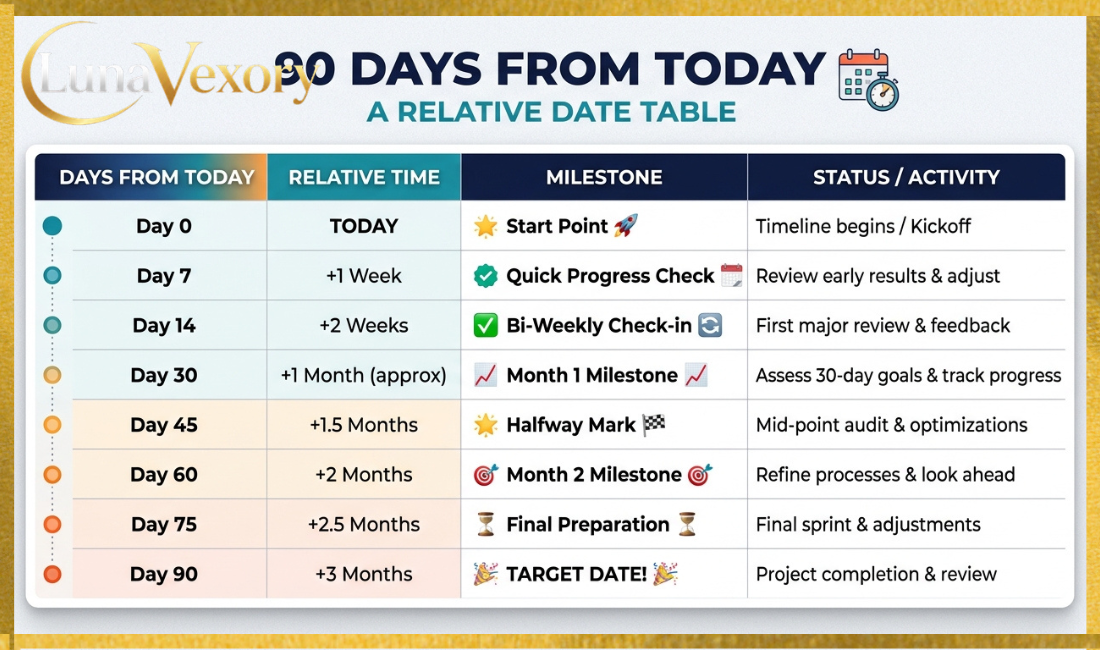
A Relative Date Table helps you see how smaller and larger intervals fit together. Instead of focusing only on the final day, you can use the intermediate dates to plan a timeline.
| Time interval | Future date | Weekday |
|---|---|---|
| 7 days | November 3, 2026 | Tuesday |
| 14 days | November 10, 2026 | Tuesday |
| 30 days | November 26, 2026 | Thursday |
| 45 days | December 11, 2026 | Friday |
| 60 days | December 26, 2026 | Saturday |
| 75 days | January 10, 2027 | Sunday |
| 90 days | January 25, 2027 | Monday |
| 120 days | February 24, 2027 | Wednesday |
| 150 days | March 26, 2027 | Friday |
These dates use October 27, 2026, as the starting point and count forward using calendar days. Notice how the intervals cross from one month to another. That is why a Future Date Calculator can be useful when you need reliable dates without manually checking the number of days in every month.
You can also use the table to create checkpoints. For example, a sixty-day review on December 26 gives you an opportunity to assess progress before the ninety-day deadline arrives.
Is 90 Days the Same as Three Months?
Not always. Ninety days and three calendar months sound like twins, but they don’t always arrive at the same destination.
A calendar month can contain 28, 29, 30, or 31 days. Adding three months to a starting date therefore produces a result that depends on the months involved.
For the current example:
| Calculation method | Result |
|---|---|
| Add 30 days | November 26, 2026 |
| Add 60 days | December 26, 2026 |
| Add 90 days | January 25, 2027 |
| Add 3 calendar months | January 27, 2027 |
The difference is two days.
If you’re setting a deadline described as “within ninety days,” use the applicable day-counting rules. If an agreement says “three months from the date of signing,” it may require a calendar-month calculation instead.
For ordinary personal planning, either method can be reasonable, but they should not be treated as interchangeable when exact timing matters.
Use a Simple Date Calculator to Find Your Future Date
A Simple Date Calculator saves you from counting days on your fingers or flipping between calendar pages. You enter a starting date, specify the interval, and receive the result.
Here is an interactive date tool you can use to calculate a future date from any starting date.
90-Day Calendar Calculator
Choose a starting date and enter the number of days to add.Starting date
10/27/26Enter days
Calculate Future Date
Calculated calendar date
Monday, January 25, 2027

90 calendar days after Tuesday, October 27, 2026
Copy Result
This tool follows standard calendar-day arithmetic. It doesn’t automatically exclude weekends, calculate working days, or account for special legal rules.
How to Add Days, Weeks, and Months to a Date
Different planning situations call for different kinds of calculations. A school assignment might need a date thirty days away, while a fitness plan might be easier to organize into twelve-week stages.
Understanding the basic options helps you choose the right method.
Add days to a date
The Add Days function moves forward by a specified number of calendar days.
For example, adding 45 days to October 27, 2026, takes you to December 11, 2026. Adding 90 days takes you to January 25, 2027.
Add weeks to a date
To Add Weeks, multiply the number of weeks by seven.
- Two weeks equal 14 days.
- Four weeks equal 28 days.
- Eight weeks equal 56 days.
- Twelve weeks equal 84 days.
Ninety days is twelve weeks and six days, so it is slightly longer than twelve weeks.
Add months to a date
Add Months moves forward by calendar months rather than by a fixed number of days. The resulting date may differ from a day-based calculation.
Many calendar tools handle dates near the end of a month according to their own documented rules. If you’re calculating a deadline on the last day of a month, verify how your chosen tool handles months that have fewer days.
Subtract days, weeks, or months
You can reverse the process using Subtract Days, Subtract Weeks, or Subtract Months.
For instance, subtracting ninety days from January 25, 2027, takes you back to October 27, 2026. This is helpful when you’re looking backward from a known deadline to determine when a project should begin.
Why People Calculate 90 Days Ahead
A ninety-day period is long enough for meaningful progress, but short enough to remain visible on a calendar. It creates a useful bridge between today’s intentions and tomorrow’s results.
Personal goals and habit building
Suppose you want to develop a reading habit, improve your cooking skills, or organize your home. Ninety days gives you time to start small, work through difficult patches, and notice the difference your efforts make.
You might divide the period into three thirty-day stages: establishing the habit, strengthening consistency, and reviewing what worked.
Work and business planning
Businesses often use quarterly planning periods to set targets, review performance, and organize projects. A ninety-day timeline can help teams schedule deliverables, monitor progress, and assign responsibility.
However, a calendar quarter and a rolling ninety-day period aren’t necessarily the same thing. A calendar quarter follows fixed boundaries, while a rolling period begins whenever you choose.
Travel and family events
Planning a family reunion, preparing for a celebration, or arranging a longer trip can involve bookings, budgets, invitations, and transport. Knowing the target date allows you to work backward and assign each task a realistic deadline.
A simple reminder system is often enough. Set an initial planning reminder, a midpoint check-in, and a final review before the event.
Education and learning
Students can use ninety-day intervals to organize revision, build a portfolio, complete a course, or prepare for an examination. Instead of waiting until the final week, they can divide the work into weekly tasks.
The trick is to give each checkpoint a clear purpose. A date on its own doesn’t complete a project, but it can encourage you to keep moving.
How to Organize the Next 90 Days
Knowing that the final date is January 25, 2027, is only the beginning. A good Timeline turns that date into a practical sequence of actions.
Consider dividing the period into three stages.
- Days 1–30: Begin and establish a routine. Define your goal, gather what you need, and decide how you’ll measure progress. Keep the first stage manageable rather than attempting to change everything at once.
- Days 31–60: Review and adjust. Check what is working, identify delays, and make realistic changes. This is also a useful time to update your budget or schedule.
- Days 61–90: Complete and evaluate. Finish outstanding tasks, confirm appointments, and review the result. If the goal continues beyond January 25, decide what the next stage should look like.
You can support this plan with a digital calendar, a paper diary, or a Calendar Tool that allows you to set reminders.
A practical tip: don’t fill every available day. Leave some breathing room for unexpected responsibilities, because a plan that allows no flexibility can become frustrating very quickly.
Frequently Asked Questions About 90 Days From Today
What is the exact date 90 days from October 27, 2026?
The exact date is Monday, January 25, 2027, counting October 28 as the first day after the starting date.
What date is ninety days from today?
For the starting date of October 27, 2026, ninety days from today is January 25, 2027. If you’re reading this on another date, use that day’s date as the starting point or enter it into the calculator above.
Is 90 days equal to 12 weeks?
Not exactly. Twelve weeks contain 84 days. Ninety days equal twelve weeks and six days.
Does a 90-day calculation include weekends?
Yes. A normal calendar-day calculation includes Saturdays and Sundays, along with public holidays. A business-day calculator follows a different method and may exclude certain days.
Can I use a date calculator to find a past date?
Yes. A Date Calculator can generally calculate both future and past dates. Enter the starting date and subtract the required number of days to find a past date.
What is the difference between a future date calculator and a duration calculator?
A Future Date Calculator identifies the date reached after adding a time interval. A Duration Calculator typically measures the interval between two dates, such as the number of days between the start and end of a project.
How can I calculate 90 days from any date?
Enter your starting date, add ninety calendar days, and check the resulting month, day, and weekday. Alternatively, use the interactive calculator in this article to perform the calculation automatically.
90 days from today
90 days from today is Monday, January 25, 2027 (based on Tuesday, October 27, 2026). You can use a date calculator to quickly find the exact future date by adding 90 calendar days.
Make Your Date Calculation More Useful
The real value of a date calculator isn’t just that it gives you an answer. It helps you turn a vague intention into something you can schedule, prepare for, and eventually complete.
If you’re working toward January 25, 2027, write the date somewhere you’ll see it. Add reminders for important milestones, break bigger tasks into smaller steps, and revisit your plan as circumstances change.
For a personal project, you might write a note such as, “By January 25, I want to have completed the first stage of my goal.” For a professional deadline, record the deliverables and any earlier dates needed for review or approval.
For a family event, work backward from the day itself so invitations, travel, and arrangements don’t become last-minute headaches.
And if you need a different interval, remember that Add Days, Add Weeks, Add Months, and their subtraction equivalents serve different purposes. Choosing the correct calculation method is just as important as getting the arithmetic right.
Read this blog https://lunavexory.com/2-weeks-from-today/
Final Thoughts
So, what is 90 days from today? When today is Tuesday, October 27, 2026, the answer is Monday, January 25, 2027.
Ninety days can pass quietly, one ordinary morning at a time, or they can become a period in which you learn something new, finish a project, prepare for a celebration, or move closer to a goal you’ve been carrying around for months.
Use the date as a starting point rather than a source of pressure. A calendar can tell you when a milestone arrives, but the small decisions you make along the way are what give that milestone its meaning.
If you have a goal you’re working toward over the next ninety days, consider sharing it in the comments. Your approach might give another reader a useful idea for making their own time count.