Have you ever looked at a calendar and wondered how quickly the next few weeks might pass? Perhaps you’re waiting for a special occasion, planning a family gathering, setting a personal goal, or simply trying to figure out when an important deadline will arrive.
Sometimes, knowing the date a few weeks ahead brings a little peace of mind, because even the busiest schedule feels easier when there’s a clear day to look forward to.
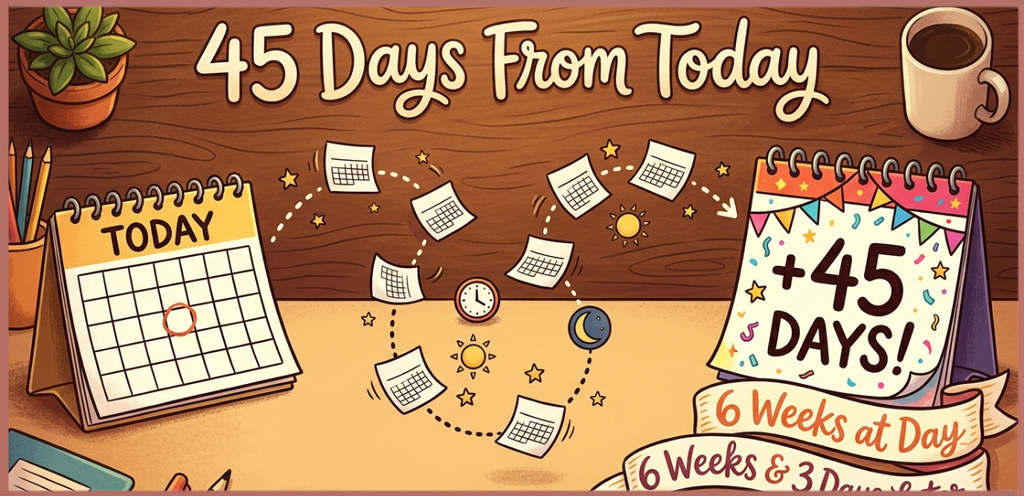
If you’re asking What Is 45 Days From Today, the answer is straightforward once we know the current date. A simple calendar calculation can help you plan appointments, prepare for celebrations, organize work, or count down to something you’ve been waiting for. Forty-five days might sound like a long stretch at first, but it passes through the calendar surprisingly quickly.
Using Friday, October 16, 2026, as today’s date, the exact date 45 days from today is Monday, November 30, 2026. That puts the date near the end of November, just as many people begin preparing for December events, winter holidays, and the final weeks of the year.
In this guide, we’ll explain the calculation, show how to find future dates without confusion, and explore practical ways to use a Date Calculator for everyday planning.
| Detail | Value |
|---|---|
| Current Date | Friday, October 16, 2026 |
| Days Added | 45 Days |
| Future Date | Monday, November 30, 2026 |
| Day of the Week | Monday |
| Total Weeks & Days | 6 Weeks, 3 Days |
| Purpose | Planning events, deadlines, travel, and schedules |
What Is 45 Days From Today?

The answer depends on the starting date, so let’s establish the calendar reference first.
45 DAYS FROM TODAY
Monday, November 30, 2026
Start date
Oct 16
Friday
+45 days
Future date
Nov 30
Monday
Calculation: October 16, 2026 + 45 calendar days = November 30, 2026.
So, 45 Days From Today falls on the last day of November 2026. The calculation uses ordinary calendar days, including Saturdays and Sundays, rather than business days alone.
This distinction is important. If you’re arranging a doctor’s appointment, preparing a birthday surprise, or setting a personal deadline, calendar days are usually what you need. But if you’re counting working days for a business agreement, the result may be different.
How Is the Exact Date Calculated?
You don’t need a complicated formula to calculate 45 days from now. All you need is the starting date and the number of days you want to move forward.
Let’s break it down using October 16, 2026.
- Current Date: Friday, October 16, 2026.
- Days remaining in October after October 16: 15 days, from October 17 through October 31.
- Days to count in November: 30 days, from November 1 through November 30.
- Total: 15 + 30 = 45 days.
Once those numbers are added together, the answer becomes clear: November 30, 2026.
This is a basic example of Date Calculation, sometimes called date arithmetic. The method works across months of different lengths, although you must account for February’s shorter length and leap years when calculations cross that month.
A Simple Date Calculator performs the same operation automatically. Instead of counting every square on a calendar, you enter the starting date, select the number of days, and let the tool identify the resulting Calendar Date.
What Day Will It Be in 45 Days?
The date isn’t the only useful detail. You might also want to know the day of the week, especially when planning a meeting, family dinner, trip, or special event.
Forty-five days after Friday, October 16, 2026, is Monday, November 30, 2026.
Here’s an easy way to check the weekday without looking up every date.
A week contains seven days. Divide 45 by 7, and you get six complete weeks with three days remaining. Six weeks after a Friday is another Friday. Moving three additional days forward takes you to Monday.
That gives us the same result through a second method.
This little trick is useful for many Relative Dates. For example, if you’re counting 14 days ahead, the weekday remains the same. If you’re counting 21 days ahead, it also stays the same because 21 is exactly three weeks.
Once you understand the pattern, calendar calculations become less mysterious and much easier to double-check.
A Quick 45-Day Calendar Breakdown
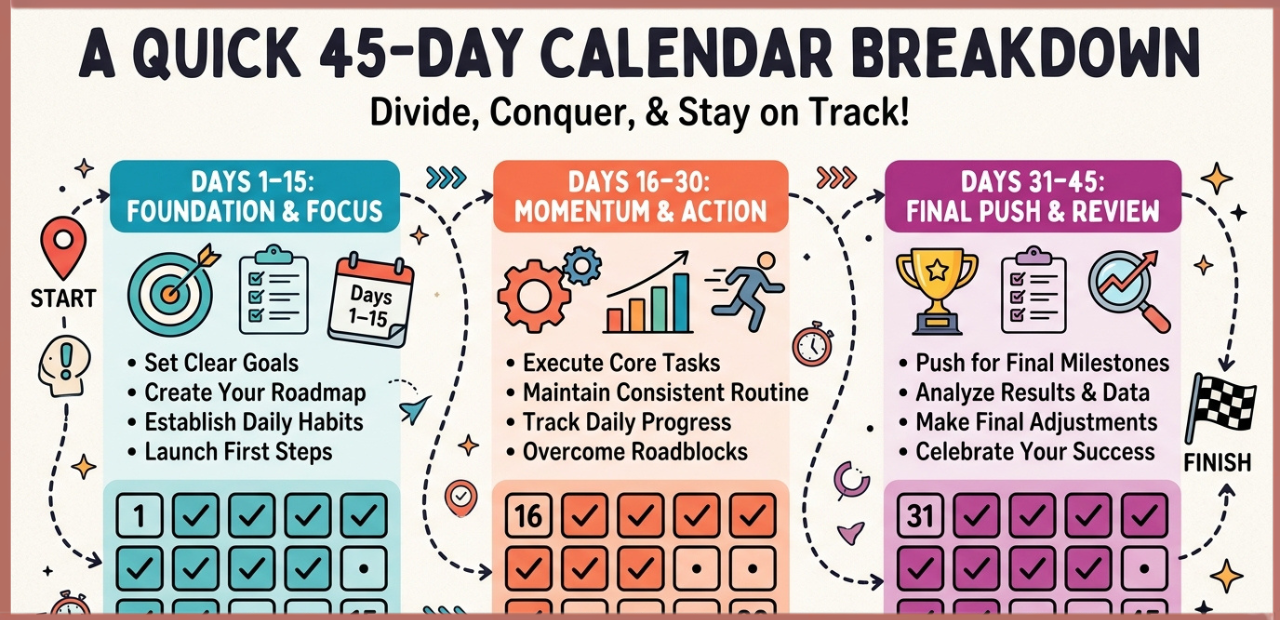
Sometimes the easiest way to understand a future date is to see how the days fit into the months.
| Calendar period | Days counted | Running total |
|---|---|---|
| October 17–31, 2026 | 15 | 15 |
| November 1–15, 2026 | 15 | 30 |
| November 16–30, 2026 | 15 | 45 |
The table shows how the Time Interval progresses from the middle of October to the end of November. Breaking the calculation into smaller pieces also makes it easier to avoid counting October 16 twice.
One common mistake is treating the starting date as day one when the intention is to add 45 complete days. Under the standard date-addition method, October 17 is day one and November 30 is day 45.
If a particular contract, event instruction, or official notice defines its counting method differently, follow that specific rule instead.
Use a Date Calculator to Find Your Future Date
An online Date Calculator can save time when you’re working with several deadlines or planning something months ahead. It can be especially helpful when the calculation crosses from one month into another.
Here’s a simple interactive date finder. Choose your starting date and enter the number of days you want to add or subtract.
Future Date Finder
Starting date
10/16/26Number of daysCalculation typeAdd daysSubtract days
Calculated calendar date
Monday, November 30, 2026
Starting date plus 45 calendar days
Reset to the 45-day example
This Days Calculator follows ordinary calendar-day arithmetic. It includes weekends and doesn’t automatically exclude public holidays.
A Future Date Calculator is useful when you need to calculate dates for school assignments, travel plans, payment reminders, project milestones, or family occasions. Instead of repeatedly checking a paper calendar, you can use a digital Calendar Calculator to find the answer in seconds.
Why Do People Calculate 45 Days From Today?
Forty-five days is a useful period because it’s long enough to make meaningful progress but short enough to plan in practical steps. It sits between a month and seven weeks, making it a convenient timeframe for many everyday commitments.
Planning Personal Goals
Perhaps you’ve decided to read more books, establish a morning routine, organize your home, or practise a new skill. A 45-day timeline gives you room to build consistency without making the goal feel endless.
You might mark October 16 as the beginning, review your progress halfway through, and use November 30 as your finishing date. Small milestones can help you stay motivated when the initial excitement fades a little.
Organizing Work and Projects
For freelancers, students, and business owners, calculating 45 days ahead can help establish project deadlines. A clear Future Timeline makes it easier to break a large assignment into research, drafting, reviewing, and final delivery stages.
Remember that a calendar deadline and a business-day deadline are not necessarily the same thing. If a client specifies 45 working days, you’ll need a Business Days Calculator or a calendar that excludes weekends and any applicable holidays.
Preparing for Family Events
A wedding anniversary, family reunion, graduation celebration, or birthday can involve more preparation than people expect. Counting 45 days ahead gives you a starting point for invitations, shopping, budgeting, and travel arrangements.
The actual event may be only one day, but the memories often begin forming weeks earlier, during all those little preparations nobody notices at first.
Managing Appointments and Reminders
Sometimes you simply need to know when to follow up on a conversation, renew a service, review a document, or check a scheduled task. A Date Finder turns a vague instruction such as “in about six weeks” into a precise date you can write down.
For medical appointments or official deadlines, however, use the date specified by the relevant professional or organization whenever one has been provided.
Understanding Relative Dates and Calendar Intervals
A Relative Date describes a day in relation to another date. Expressions such as “45 days from today,” “two weeks ago,” and “three months from now” are common examples.
They’re convenient because you don’t need to know the exact date when you first make the plan. You only need a starting point and a time interval.
Consider these common examples based on October 16, 2026.
| Relative date | Calendar result |
|---|---|
| 30 days ago | September 16, 2026 |
| 60 days ago | August 17, 2026 |
| 90 days ago | July 18, 2026 |
| 120 days ago | June 18, 2026 |
| 150 days ago | May 19, 2026 |
| Today | October 16, 2026 |
| 30 days ahead | November 15, 2026 |
| 60 days ahead | December 15, 2026 |
| 90 days ahead | January 14, 2027 |
| 120 days ahead | February 13, 2027 |
| 150 days ahead | March 15, 2027 |
These examples demonstrate why a Relative Date Calculator can be useful. Months don’t all contain the same number of days, so adding 30 days isn’t always equivalent to adding one calendar month.
For example, 30 days after October 16 is November 15. One calendar month after October 16 is November 16. Those dates are close, but they aren’t identical.
The same distinction matters when calculating weeks from today, months from today, or years from today. A Date Duration Calculator works with specified time intervals, while calendar-month calculations follow calendar rules rather than treating every month as 30 days.
How Long Is 45 Days in Weeks and Hours?
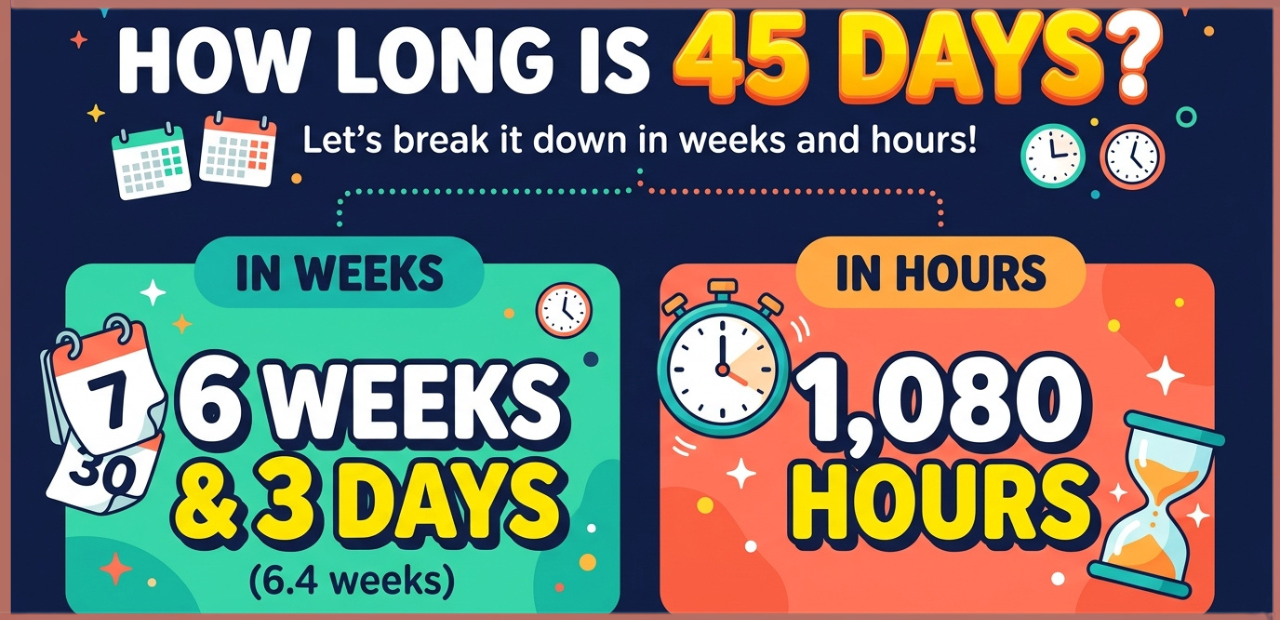
Understanding the length of a period in different units can make a deadline easier to visualize.
Forty-five days equals:
- 6 weeks and 3 days, because six weeks contain 42 days.
- 1,080 hours, because 45 multiplied by 24 equals 1,080.
- 64,800 minutes, because 1,080 multiplied by 60 equals 64,800.
- 3,888,000 seconds, assuming each day contains 24 hours.
These conversions describe the mathematical duration of 45 standard days. Actual elapsed hours between local timestamps can differ around daylight-saving transitions in locations that observe them.
For most ordinary planning, however, calendar days are sufficient. You usually don’t need to calculate every hour when arranging a family dinner or setting a study target.
A Time Interval Calculator becomes more useful when you need the exact difference between two dates and times, such as the length of a shift or the time remaining before a scheduled event.
Calendar Days vs. Business Days
One important question is whether the 45-day period includes weekends. In a standard calendar calculation, it does.
If you’re counting from Friday, October 16, 2026, then Saturday and Sunday count toward the 45 days. That’s why the result lands on Monday, November 30.
Business-day calculations work differently. They commonly exclude Saturdays and Sundays, and may also exclude public holidays, depending on the rules being used.
For example, a business agreement might require a response within 45 working days. You shouldn’t assume that means November 30, because excluding weekends will generally push the deadline further into the future. The final date will also depend on whether the starting date counts and which holidays apply.
Use a Working Days Calculator when the instruction specifically mentions working days, office days, or business days. For a simple countdown, personal goal, or ordinary calendar reminder, the regular Days From Today Calculator is usually the right choice.
Tips for Counting 45 Days Without Making Mistakes
Even a simple date calculation can become confusing when you’re tired or juggling several plans. A few small habits make the process more reliable.
- Write down the starting date. Don’t rely on memory, particularly when you’re counting from a date mentioned in an email or document.
- Choose calendar days or business days. This one detail can change the final result significantly.
- Check month lengths. October has 31 days, November has 30, and February has either 28 or 29.
- Confirm the counting convention. Adding 45 days normally means moving forward 45 complete days, not counting the starting date as day one.
- Save the result to your calendar. A reminder can prevent a calculated deadline from slipping your mind.
- Double-check important dates. For legal, financial, travel, or official matters, verify the relevant instructions before relying on a calculated result.
A little attention at the beginning can save a surprising amount of stress later. The point of a Calendar Tool isn’t merely to give you a number; it’s to help you make plans with more confidence.
What Happens Around November 30, 2026?
Because the calculated date is November 30, it falls near the transition from autumn into winter in the Northern Hemisphere. Many households begin preparing for December celebrations, shopping, travel, and the end of the year around this time.
For some people, the date might mark the end of a savings challenge. For others, it could be the deadline for completing a course, reviewing monthly expenses, or organizing plans before the festive season begins.
It can also be a useful checkpoint for goals started in October. If you begin a 45-day challenge on October 16, November 30 provides a natural opportunity to review what worked, what felt difficult, and what you’d like to continue.
The date itself doesn’t need to be tied to a major event to be meaningful. Sometimes, an ordinary Monday becomes important because it’s the day you planned to finish something that matters to you.
A Brief Note on Historical Timelines

Calendar calculations are also useful when studying history. Historians regularly compare dates, measure the intervals between events, and organize records into a Historical Timeline.
For example, researchers might study Prohibition in the United States, including the 18th Amendment, the Volstead Act, and the later 21st Amendment. They might examine the Great Depression following the Stock Market Crash, or trace the history of the Berlin Wall and German reunification.
Other timelines cover the Mayflower Compact, John F. Kennedy, and Barack Obama, placing important political and social events in chronological order.
These examples involve much longer periods than 45 days, but the underlying idea is similar: start with a known date and determine how events relate to one another over time.
Historical research often requires additional care because calendars, time zones, and the conventions used in old records can differ. Still, the basic principle of measuring a Date Difference remains an important part of understanding chronology.
Frequently Asked Questions About 45 Days From Today
What is 45 days from today?
Using Friday, October 16, 2026, as the starting date, 45 days from today is Monday, November 30, 2026. This calculation includes weekends and uses standard calendar-day counting.
What date is 45 days from today?
The exact date is November 30, 2026, when the starting date is October 16, 2026. If you’re reading this on another day, enter your actual current date into a Future Date Finder to get the updated answer.
What day will it be in 45 days?
It will be Monday, November 30, 2026, based on the October 16 starting date. Forty-five days equals six weeks and three days, so the weekday moves forward by three days.
How do I calculate 45 days from now manually?
Count the days remaining after your starting date in the first month, then continue into the following month until you reach 45. For October 16, there are 15 days from October 17 through October 31, followed by 30 days in November. The total is 45.
Is 45 days the same as a month and a half?
Not exactly in every calendar situation. Forty-five days is approximately six weeks and three days, or around a month and a half. But calendar months vary in length, so adding one and a half calendar months may not always produce the same result.
Does a 45-day calculation include today?
Standard date addition does not count today as the first complete day. If today is October 16, day one is October 17, and day 45 is November 30. Some official instructions use different counting conventions, so always check the wording when a deadline is important.
Can I use a date calculator for dates in the past?
Yes. A Date Calculator can usually add days to find future dates or subtract days to identify past dates. The same method works whether you’re checking a date 45 days ahead or reviewing something that happened 45 days ago.
Is 45 days from today a business-day calculation?
No. The date given in this article is based on calendar days, which include weekends. A business-day calculation requires a different method and may also need to account for public holidays.
Frequently Asked Question
What was 45 days ago
Forty-five days ago from today was September 1, 2026. You can use a date calculator to quickly determine past dates based on any number of days.
What is 45 days from today?
45 days from today is Monday, November 30, 2026. This date is calculated by adding 45 calendar days to today’s date.
Whats 45 days from today
45 days from today falls on Monday, November 30, 2026. It’s a simple way to find a future date for planning events, deadlines, or appointments.
What’s 45 days from today
What’s 45 days from today? The answer is Monday, November 30, 2026. Counting forward 45 days from today gives you this exact calendar date.
Today plus 45 days
Today plus 45 days is Monday, November 30, 2026. Use this calculation to schedule future plans, projects, meetings, or important occasions.
Conclusion
Knowing What Is 45 Days From Today is a small piece of information that can make everyday planning much easier. Starting from Friday, October 16, 2026, the exact future date is Monday, November 30, 2026.
Whether you’re organizing a project, preparing for a special occasion, or simply curious about the calendar, the calculation gives you a clear point to work toward.
Remember that the best way to calculate future dates is to start with the correct current date, decide whether you need calendar days or working days, and check the result before relying on it for an important deadline.
You can also use the interactive calculator above whenever you need to add days, subtract days, or explore other Relative Dates. A few seconds of calendar planning today can help make the weeks ahead feel more organized.
And if you’re using November 30 as a personal milestone, give yourself something positive to look forward to. It might be finishing a goal, sharing time with family, or simply looking back at how far you’ve come since October. Every date on the calendar is another opportunity to begin something, complete something, or appreciate the little moments along the way.