

Time has a funny way of moving. One moment, you’re looking at today’s calendar, making plans for the coming week, and the next, you’re wondering how quickly the next few months will arrive.
Maybe you’re waiting for a special family celebration, preparing for an important deadline, or counting down to a moment that means the world to you. Sometimes, knowing the exact date can make the future feel a little closer and much easier to plan for.
If you’ve been wondering What is 20 Weeks From Today?, you’re in the right place. A period of twenty weeks may sound like a long stretch of time, but it can pass surprisingly quickly.
That’s why having an accurate date calculation is useful, whether you’re planning a personal milestone, organizing a project, or simply curious about the calendar.
Using Thursday, October 22, 2026, as today’s date, the answer is Thursday, March 11, 2027.
That’s exactly 140 days into the future. It takes us from the final months of 2026 into the early part of 2027, creating a useful timeline for everything from personal goals to professional commitments.
In this guide, we’ll explore the exact future date, explain how to calculate twenty weeks manually, and discuss how a Date Calculator can help you organize your plans. We’ll also look at practical ways to use a twenty-week countdown, because a calendar is not just about numbers; it’s about making time work for you.
| Information | Date |
|---|---|
| Today’s Date | October 22, 2026 |
| 20 Weeks From Today | March 11, 2027 |
| Day of the Week | Thursday |
| Total Days | 140 Days |
What Is 20 Weeks From Today?
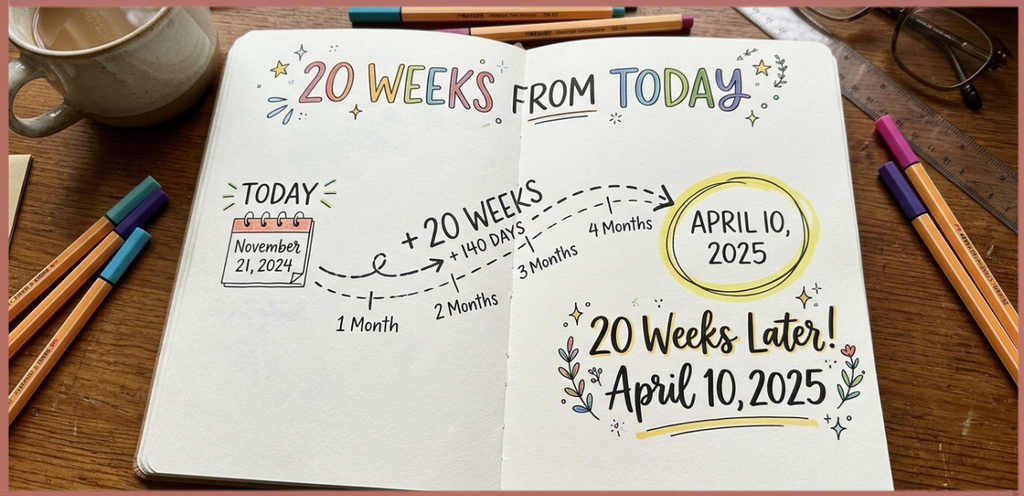
The answer depends on the current date. For this calculation, we’re using Thursday, October 22, 2026, as the starting point.
Here’s the exact result:
| Date Calculation | Result |
|---|---|
| Today’s Date | Thursday, October 22, 2026 |
| Number of Weeks | 20 weeks |
| Total Days | 140 days |
| Future Date | Thursday, March 11, 2027 |
| Day of the Week | Thursday |
| Approximate Duration | 4 months and 17 days |
| Calendar Year | 2027 |
So, 20 Weeks From Today is Thursday, March 11, 2027.
If you’re using this date for a birthday, appointment, project deadline, or special occasion, you can mark it on your calendar with confidence. The calculation adds twenty complete weeks to the starting date, rather than counting October 22 as the first day.
This is the standard method used by most online date calculators. It keeps the calculation consistent and makes it easier to compare future dates.
Quick Answer: Date in 20 Weeks
Sometimes you don’t need a lengthy explanation. You just want to know what day it will be twenty weeks from now.
The quick answer is:
Thursday, March 11, 2027.
If today’s date is October 22, 2026, then the Date in 20 Weeks falls on March 11, 2027.
You can use this future date for:
- Planning a birthday or anniversary.
- Organizing a family gathering.
- Setting a personal goal.
- Preparing for an exam.
- Calculating a project deadline.
- Scheduling an appointment.
- Creating a countdown for an upcoming event.
Twenty weeks gives you a reasonable amount of time to prepare for many important occasions. It is long enough to make meaningful progress, but not so far away that the date feels impossible to imagine.
A little calendar planning today can save you a lot of last-minute stress later.
How to Calculate 20 Weeks From Today Manually
You don’t need an online tool to calculate twenty weeks from a particular date. The process is actually quite simple once you understand how weeks work.
One week contains seven days.
Therefore:
20 weeks × 7 days = 140 days.
Now, add 140 days to October 22, 2026.
You can do this by moving forward through the calendar month by month.
| Month | Days Added | Remaining Days |
|---|---|---|
| October 2026 | 9 | 131 |
| November 2026 | 30 | 101 |
| December 2026 | 31 | 70 |
| January 2027 | 31 | 39 |
| February 2027 | 28 | 11 |
| March 2027 | 11 | 0 |
After adding all the days, the calculation reaches March 11, 2027.
This is a simple example of Date Arithmetic, which involves adding or subtracting days, weeks, or months from a calendar date.
The method works for many different date calculations, including finding a date 30 days from today, calculating a date 90 days ago, or determining what day falls six weeks ahead.
The important thing is to keep track of how many days remain as you move from one month to another. Since months have different lengths, a little care can prevent an incorrect result.
Understanding 20 Weeks Ahead in Days, Months, and Hours
Twenty weeks is a fixed time interval, but people often describe it in different ways.
Some prefer weeks because they are easy to visualize. Others think in months, especially when planning family events or appointments.
Here’s how twenty weeks compares with other units of time:
| Time Measurement | Equivalent |
|---|---|
| Weeks | 20 weeks |
| Days | 140 days |
| Hours | 3,360 hours |
| Minutes | 201,600 minutes |
| Seconds | 12,096,000 seconds |
| Approximate Months | 4 months and 17 days |
These conversions can be helpful when you’re planning different types of activities.
For example, someone preparing for a major project may prefer to think in days, while someone planning a celebration might prefer months.
Twenty weeks also gives you a useful timeline for dividing a large goal into smaller steps. Rather than waiting until March 11, 2027, to see the result, you can monitor progress along the way.
A long timeline can become much easier to manage when you break it into smaller pieces.
Calendar Breakdown: From October 22, 2026, to March 11, 2027
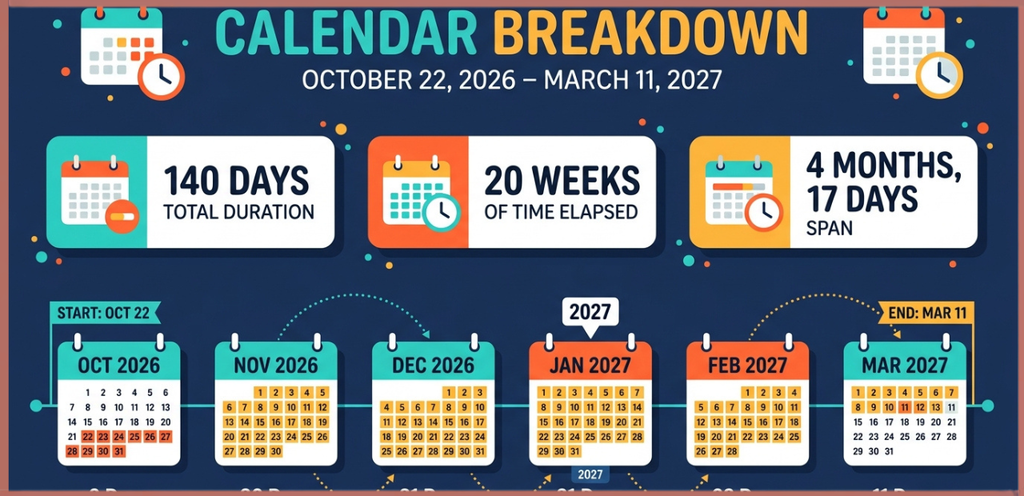
Looking at a calendar can make a future date easier to understand.
The following dates show how the calendar progresses over the twenty-week period.
| Date | Day |
|---|---|
| October 22, 2026 | Thursday |
| November 22, 2026 | Sunday |
| December 22, 2026 | Tuesday |
| January 22, 2027 | Friday |
| February 22, 2027 | Monday |
| March 11, 2027 | Thursday |
Notice that the final date falls on the same weekday as the starting date.
This happens because twenty weeks contains exactly 140 days, and 140 is evenly divisible by seven.
Every seven days, the weekday repeats. So, adding twenty complete weeks to a Thursday brings you to another Thursday.
This is one of the useful little details of Calendar Calculation. Once you understand the relationship between weeks and weekdays, some future-date calculations become much easier.
What Is a Date Calculator?
A Date Calculator is an online tool that helps you find future or past dates by adding or subtracting time.
You enter a starting date, choose the number of days, weeks, or months, and the calculator produces the result.
For example, if you enter October 22, 2026, and add twenty weeks, the calculator returns March 11, 2027.
A Simple Date Calculator can be useful for many everyday situations, including:
- Calculating future dates.
- Finding dates in the past.
- Working out the number of days between two dates.
- Planning appointments.
- Creating project timelines.
- Organizing personal milestones.
- Tracking countdowns.
Some tools also include a Relative Date Range feature, which allows you to calculate the duration between two specific dates.
For instance, you could enter October 22, 2026, as the starting date and March 11, 2027, as the ending date. The tool would show that the difference is 140 days, or twenty weeks.
A calendar tool can be particularly useful when you need to check several dates quickly. Instead of counting weeks manually every time, you can use an online calculator to get an accurate answer.
How to Use a Future Date Calculator
A Future Date Calculator is designed to make date calculations quick and convenient.
Most tools have a simple interface with a few fields. You don’t need to understand complicated calendar mathematics to use one.
Here’s a typical process:
- Open a Future Date Calculator or Weeks Calculator.
- Select the starting date.
- Choose the option to add weeks.
- Enter 20 in the weeks field.
- Click Calculate Date.
- Review the result.
The calculator should display Thursday, March 11, 2027.
Some advanced tools include additional options such as Add Days, Subtract Days, Add Weeks, Subtract Weeks, Add Months, and Subtract Months.
These options make it easier to adjust a timeline without starting from scratch.
For example, suppose you calculate a project deadline twenty weeks ahead, but then discover that the project needs to be completed two weeks earlier. You can simply subtract two weeks from the original result.
This is where a Calendar Calculator becomes especially useful. It allows you to explore different dates and adjust your schedule as your plans change.
Why Accurate Date Calculation Matters
A future date may seem like a small detail, but it can have a significant effect on planning.
Imagine preparing for an important exam, arranging travel, or organizing a large family celebration. If you calculate the date incorrectly, you could end up with less preparation time than expected.
Accurate date calculation helps reduce confusion and makes it easier to stay organized.
Calendar Days vs. Working Days
One important distinction is the difference between calendar days and working days.
Calendar days include every day of the week, including weekends and holidays.
Working days generally refer to weekdays, although the exact definition depends on the organization, country, or type of work involved.
If you add twenty weeks to October 22, 2026, the result is March 11, 2027, using calendar days.
However, if you’re calculating twenty working weeks, you may need to account for public holidays and other non-working days.
For example, a business might use working days when calculating processing times or project deadlines. A personal countdown will usually use calendar days.
Always check which method applies to your situation, especially when dealing with official deadlines.
Inclusive and Exclusive Date Counting
Another common source of confusion is whether the starting date counts as day one.
In standard date arithmetic, adding twenty weeks means moving forward by 140 full days.
October 23, 2026, is day one, and March 11, 2027, is day 140.
Some legal or administrative processes may use a different counting method. If you’re calculating an official deadline, it’s important to follow the instructions provided by the relevant organization.
A Date Difference Calculator can help you compare dates, but you should still understand the counting method used.
Planning 20 Weeks Ahead for Personal Milestones

Twenty weeks can be a meaningful amount of time for preparing for something special.
Maybe you’re planning a birthday, organizing a family gathering, or working toward a personal goal. Having a future date gives you something to focus on.
The best part is that you don’t have to do everything at once.
Planning a Birthday or Anniversary
A birthday or anniversary is often more enjoyable when the preparation is spread over time.
If you’re planning an event for March 11, 2027, you can use October 22, 2026, as your starting point.
During the first few weeks, you might decide on the location, guest list, and budget. Later, you can arrange invitations, decorations, and other details.
A twenty-week timeline gives you enough room to make thoughtful choices without feeling rushed.
And if the celebration is for someone you love, the preparation itself can become part of the happiness. Sometimes the little details mean just as much as the big day.
Preparing for a Family Milestone
Family milestones often bring people together in beautiful ways.
Welcoming a newborn, celebrating an anniversary, or organizing a family reunion can create memories that last for years.
If you’re preparing for a special occasion in March, a twenty-week timeline can help you arrange travel, organize invitations, and plan activities.
For example, a family welcoming a baby girl may use the coming months to prepare a nursery, organize a gathering, or simply make time for the changes ahead.
Every family celebrates differently, and there is no single perfect way to welcome a new chapter.
What matters most is the love, care, and thoughtful preparation behind the occasion.
Setting a Personal Goal
Twenty weeks can also be a useful period for personal development.
You might want to learn a new skill, improve your fitness, read more books, or establish a healthier routine.
Instead of focusing only on the final date, divide the time into smaller milestones.
For example:
- Weeks 1–5: Establish a routine.
- Weeks 6–10: Build consistency.
- Weeks 11–15: Review your progress.
- Weeks 16–20: Refine your approach and prepare for the next goal.
This approach can make a large goal feel more manageable.
You don’t need to achieve everything in a single week. Small improvements, repeated consistently, can lead to meaningful results.
Using a Date Calculator for Project Deadlines
Project planning often involves multiple deadlines, and a Project Timeline Calculator can help organize them.
Suppose a project begins on October 22, 2026, and must be completed within twenty weeks.
The final date would be March 11, 2027.
You could then divide the project into smaller stages, each with its own target date.
| Project Stage | Suggested Date |
|---|---|
| Initial planning | October 22, 2026 |
| First progress review | November 19, 2026 |
| Second progress review | December 17, 2026 |
| Third progress review | January 14, 2027 |
| Fourth progress review | February 11, 2027 |
| Final deadline | March 11, 2027 |
This example uses four-week milestones to create a regular review schedule.
The dates are planning references rather than a recommendation that every project should follow the same timeline. Your actual milestones will depend on the size and requirements of the work.
A Timeline Calculator can help you organize tasks, compare deadlines, and identify how much time remains before a project is due.
Other Dates You Can Calculate With a Date Calculator
A Date Calculator isn’t limited to adding twenty weeks.
You can use it to explore many different calendar questions, such as what date falls six weeks from today, how many days remain until a holiday, or what date occurred 90 days ago.
A Relative Date Calculator can handle both future and past dates, making it useful for many situations.
Here are some examples using October 22, 2026, as the starting date.
| Date Calculation | Result |
|---|---|
| 2 weeks from October 22, 2026 | November 5, 2026 |
| 4 weeks from October 22, 2026 | November 19, 2026 |
| 8 weeks from October 22, 2026 | December 17, 2026 |
| 12 weeks from October 22, 2026 | January 14, 2027 |
| 16 weeks from October 22, 2026 | February 11, 2027 |
| 20 weeks from October 22, 2026 | March 11, 2027 |
These calculations can be helpful when creating a countdown, planning an event, or organizing a personal schedule.
The same method works for anniversaries, appointments, travel plans, and many other occasions.
The Difference Between Adding Weeks and Adding Months
One common date calculation mistake is assuming that twenty weeks is the same as five months.
Twenty weeks contains 140 days.
Five calendar months, however, can contain a different number of days depending on the months involved.
For example:
- October 22, 2026, plus 20 weeks is March 11, 2027.
- October 22, 2026, plus 5 calendar months is March 22, 2027.
The difference is eleven days.
This distinction matters when you’re planning events or calculating deadlines. If an instruction says twenty weeks, use a week-based calculation. If it says five months, use a month-based calculation.
A Calendar Calculator can make these calculations easier, but the input still needs to match the situation.
Historical Dates and the Importance of Calendar Accuracy

Calendars help us understand not only the future but also the past.
Historical events are often remembered by their dates, and calculating the time between important moments can help us understand how history unfolded.
For example, someone studying the American Civil Rights Movement might compare the dates of the Montgomery Bus Boycott, the Greensboro Sit-ins, and other significant events.
A student learning about the Fall of the Berlin Wall may use a historical timeline to understand the progression of events during the Cold War.
Similarly, dates associated with the Wright Brothers’ First Flight, the Pearl Harbor Attack, or the Kennedy Assassination help place historical events in chronological order.
A timeline is a useful learning tool because it turns separate dates into a connected story.
However, historical date calculations sometimes require special care. Different calendar systems, time zones, and historical calendar changes can affect how dates are interpreted.
For modern dates such as October 22, 2026, and March 11, 2027, standard Gregorian calendar arithmetic provides a straightforward answer.
Frequently Asked Questions About 20 Weeks From Today
What is the date 20 weeks from today?
If today is Thursday, October 22, 2026, the date 20 weeks from today is Thursday, March 11, 2027.
What day is 20 weeks from today?
It will be Thursday, March 11, 2027. Adding twenty complete weeks to a Thursday brings you to another Thursday.
How many days are in 20 weeks?
There are 140 days in twenty weeks. This is calculated by multiplying twenty by seven.
Is 20 weeks equal to five months?
Not exactly. Twenty weeks equals 140 days, while five calendar months can contain a different number of days. In this example, five calendar months after October 22, 2026, is March 22, 2027.
How do I calculate 20 weeks from today without a calculator?
Multiply twenty by seven to get 140 days. Then add 140 days to the current date. Starting from October 22, 2026, the result is March 11, 2027.
Can I use a date calculator to find a date in the past?
Yes. Most online date calculators allow you to add or subtract days, weeks, or months. To find a date twenty weeks ago, subtract 140 days from the current date.
Does a 20-week calculation include weekends?
Yes. Standard date calculations count calendar days, including Saturdays and Sundays. If you need to calculate working days, you’ll need a business-day calculator or a tool that excludes weekends and applicable holidays.
Why does the answer change when I use a different date calculator?
The starting date may be different, or the calculator may use a different counting method. Some tools may calculate working days rather than calendar days. Always check the starting date and settings before relying on the result.
Frequently Asked Question
20 weeks ago
20 weeks ago was Thursday, June 4, 2026. Since 20 weeks equals 140 days, this date is exactly 140 days before today.
What is 20 weeks from today
20 weeks from today is Thursday, March 11, 2027. Adding 20 weeks (140 days) to today’s date gives you this exact future date.
20 weeks from now
20 weeks from now falls on Thursday, March 11, 2027. It’s the same as adding 140 days to the current date.
When was 20 weeks ago
20 weeks ago was Thursday, June 4, 2026. This calculation subtracts exactly 140 days from today’s date.
What day was it 20 weeks ago
20 weeks ago, the day was Thursday. The exact date was June 4, 2026, which occurred 140 days before today.
Read this blog https://lunavexory.com/what-day-is-3-weeks-from-today-2/
Conclusion: Make the Most of the Next 20 Weeks
Knowing What is 20 Weeks From Today is a simple way to bring clarity to your future plans.
Starting from Thursday, October 22, 2026, the exact date after twenty weeks is Thursday, March 11, 2027.
Whether you’re preparing for a special celebration, organizing a project, setting a personal goal, or simply satisfying your curiosity, understanding how to calculate future dates can make everyday planning easier.
A calendar is more than a collection of numbers. It’s a reminder that time keeps moving, and every day offers another opportunity to prepare, grow, and create meaningful memories.
If you’re planning something important, consider using a Future Date Calculator or Weeks Calculator to confirm your dates. You can also mark the final date on your personal calendar and set reminders for the milestones along the way.
And here’s a little thought to take with you: twenty weeks may seem like a long time when you’re waiting for something exciting, but it can pass quicker than expected. Use those days thoughtfully, enjoy the little moments, and give yourself something wonderful to look forward to.
Have you ever used a twenty-week countdown to prepare for a special event or personal goal? Share your favorite planning tips or experiences in the comments. Your idea might help someone else make their next twenty weeks a little more meaningful.