
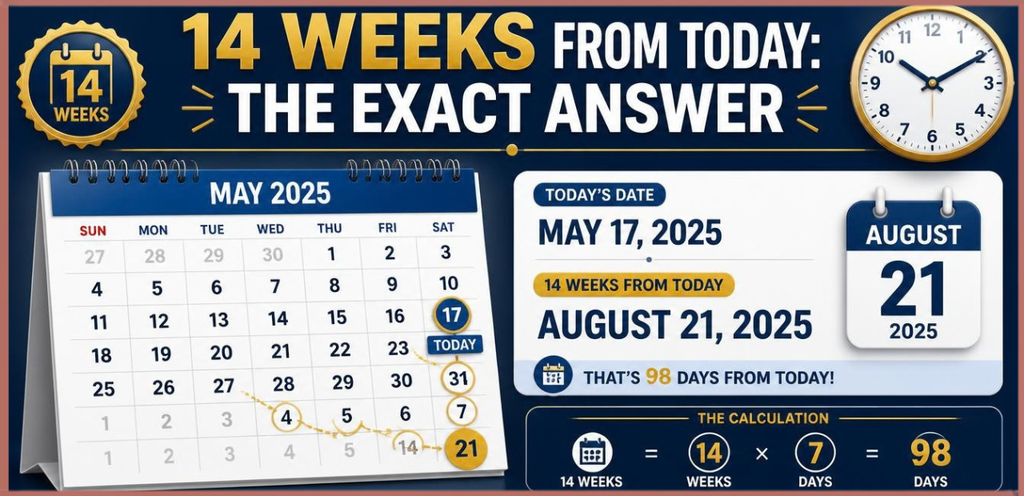
There is something oddly satisfying about asking a simple question like what is 14 weeks from today. A week feels short enough to almost ignore, but fourteen of them quietly stretch into a whole season of life.
Plans change, babies grow, projects get finished, holidays appear on the calendar, and somehow the date that looked far away suddenly arrives. If today is October 2, 2026, then 14 weeks from today is January 8, 2027, which falls on a Friday.
That answer is not a guess, and it doesn’t depend on how long a month happens to feel. Fourteen weeks contains exactly 98 days, so the calculation can be made cleanly by adding 98 days to October 2, 2026. A small bit of calendar arithmetic, yes, but it can be surprisingly useful when you’re trying to plan something in the future.
Maybe you’re counting toward a birthday, a new baby, a wedding, a trip, a school deadline, or simply wondering where the calendar will land after a particular amount of time. Whatever brought you here, this guide explains the date 14 weeks from today, how to calculate it yourself, and what interesting historical dates sit around that same part of the calendar.
14 Weeks From Today: The Exact Answer
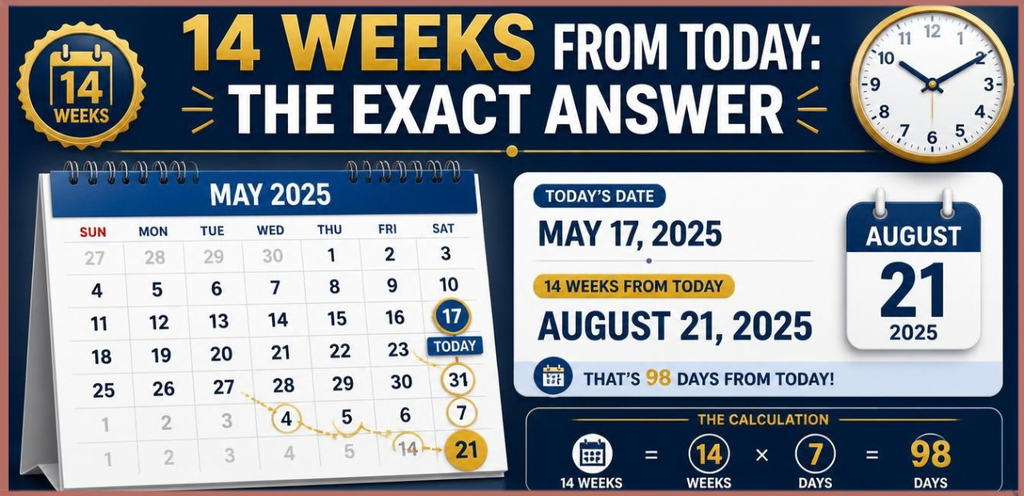
If today is October 2, 2026, the answer is:
- Today: October 2, 2026
- Time period: 14 weeks
- Number of days: 98 days
- Future date: January 8, 2027
- Day of the week: Friday
- Date interval: October 2, 2026 through January 8, 2027
So, 14 weeks from October 2 2026 is January 8, 2027.
The easiest way to understand it is to remember that one week has seven days. Multiply 14 by 7 and you get 98. From there, the calendar does the rest. It crosses October, November and December before arriving in January, which is why a period that sounds like “just fourteen weeks” actually carries you into a completely different year.
For anyone using a date calculator, this is the kind of calculation where entering the starting date and adding 14 weeks should produce the same result. Still, knowing the arithmetic is handy because sometimes you don’t have a calculator widget sitting in front of you, and your phone battery is at that dramatic 3 percent.
How to Calculate 14 Weeks From Today
A date calculation involving weeks is easier than one involving months because every week has the same length. Months are a little mischievous in this regard: some contain 28 days, others 30, and others 31.
To calculate 14 weeks, use this simple formula:
14 weeks × 7 days = 98 days
Now start with October 2, 2026 and add 98 days.
October has 31 days, so from October 2 to October 31 there are 29 days remaining if you’re counting forward from the starting date. November contributes another 30 days, and December contributes 31. That gets us to the end of December, with the remaining days carrying into January.
The result is January 8, 2027.
This is why a proper future date calculator can be useful. You don’t have to mentally juggle month lengths, leap years, or whether you’ve accidentally counted the starting day twice. You simply enter the date, select weeks, enter 14, and let the calculator perform the date arithmetic.
A quick calculation
- October 2 starting date
- 1 week October 9
- 2 weeks October 16
- 4 weeks October 30
- 8 weeks November 27
- 12 weeks December 25
- 14 weeks January 8, 2027
That little sequence is also a nice way to see how the date 14 weeks ahead develops rather than appearing magically at the end.
14 Weeks From Today in Days, Weeks, and Months
When someone asks how many days are 14 weeks, the answer is wonderfully uncomplicated: 98 days.
The month equivalent is less exact because a month isn’t a fixed number of days. Fourteen weeks is approximately 3.2 months, depending on which months are being compared. It is therefore better to say “98 days” when precision matters.
Here is a useful comparison:
- 14 weeks = 98 days
- 14 weeks = 1,344 hours
- 14 weeks = 80,640 minutes
- 14 weeks = 4,838,400 seconds
The hours and minutes are mostly for fun, of course. Nobody planning a January appointment usually says, “I’ll see you in 80,640 minutes.” Unless they’re trying very hard to make a dentist appointment sound like a space mission.
For practical planning, weeks and days are the most useful measurements. A doctor, trainer, teacher, event planner, or project manager may prefer weeks because recurring schedules naturally work that way.
What Date Is 14 Weeks From Today?
The most common version of this search is what date is 14 weeks from today. Using October 2, 2026 as today’s date, the answer remains:
January 8, 2027.
It is a Friday, which may matter if you’re planning a weekend event. The following Saturday is January 9, while Sunday is January 10. So if your fourteen-week countdown ends on Friday, you have a convenient weekend immediately afterward.
This can be useful for all sorts of ordinary life plans. A person starting a fitness program on October 2 might use January 8 as a check-in point. Someone organizing a family gathering could see whether that weekend works. A student could use the date as a milestone for a longer assignment.
The important thing is to distinguish 14 weeks after today from “three months from today.” Those aren’t automatically the same date. Weeks are based on seven-day intervals, while months follow the calendar.
14 Weeks From Today: A Simple Weekly Calendar
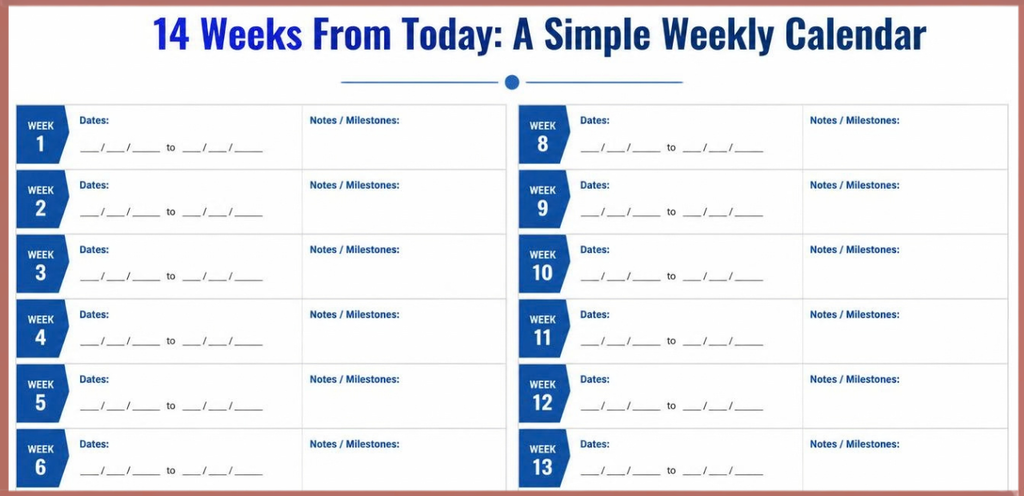
Sometimes the easiest weeks calculator is simply a little calendar written out in plain language.
- 1 week from October 2, 2026 October 9, 2026
- 2 weeks October 16, 2026
- 3 weeks October 23, 2026
- 4 weeks October 30, 2026
- 5 weeks November 6, 2026
- 6 weeks November 13, 2026
- 7 weeks November 20, 2026
- 8 weeks November 27, 2026
- 9 weeks December 4, 2026
- 10 weeks December 11, 2026
- 11 weeks December 18, 2026
- 12 weeks December 25, 2026
- 13 weeks January 1, 2027
- 14 weeks January 8, 2027
Notice something rather neat: because the interval is always a whole number of weeks, every date lands on a Friday. That’s one advantage of thinking in weekly intervals; the day of the week doesn’t wander off somewhere unexpected.
What Is 14 Weeks From Today Good for Planning?
A future date 98 days away can feel distant, but fourteen weeks is actually a useful planning window. It is long enough for meaningful change and short enough that a deadline doesn’t become some vague creature lurking in the future.
You might use a date calculator from today for:
- Pregnancy or prenatal planning milestones
- Fitness and training programs
- School and university projects
- Business or marketing campaigns
- Travel preparation
- Wedding planning
- Home renovation schedules
- Personal savings goals
- Habit-building challenges
- Work or certification deadlines
For example, someone beginning a fourteen-week learning plan on October 2 could use January 8 as the completion date. Another person might divide those 14 weeks into smaller four-week or seven-day targets, making a big goal feel much less enormous.
There is also something psychologically useful about a precise date. “Sometime in January” is fuzzy. January 8, 2027 is not.
What Was Happening Around These Calendar Dates in History?
A date calculator tells you where you’re going, but calendars can also remind you where people have already been. The October-to-January stretch contains a surprisingly dense collection of historical anniversaries.
For example, October 12, 1492 is traditionally associated with Christopher Columbus reaching islands in the Americas. The event became a major turning point in European-Amercian contact, followed by the enormous and often devastating Columbian Exchange, colonization, displacement, and cultural transformation.
Describing the event only as an “exploration” can miss the suffering and upheaval experienced by Indigenous peoples, so the broader historical context matters.
Then comes October 14, 1962, the date on which U.S. reconnaissance imagery provided evidence of Soviet missile installations in Cuba. This helped set the stage for the Cuban Missile Crisis, one of the most dangerous confrontations of the Cold War.
History takes another turn on October 29, 1929, remembered as Black Tuesday, when a dramatic stock-market collapse intensified an already serious economic crisis. The following Great Depression brought widespread unemployment, poverty, bank failures, and hardship in the United States and beyond.
The calendar keeps moving, even when history feels enormous.
November Dates That Changed the World
November contains several dates connected with major political and social transformations.
On November 4, 2008, Barack Obama was elected president of the United States. His election was historically significant, particularly because he became the first African American to hold the presidency.
On November 9, 1989, the Berlin Wall opened, an event that became one of the most recognizable symbols of the collapse of communist governments in Eastern Europe. German reunification followed the next year, while the Soviet Union itself dissolved in 1991.
Another important date is November 21, 1620, associated with the Mayflower Compact, an early document connected with self-government among English colonists in North America. Its historical importance is often discussed alongside the complicated realities of colonial expansion and the experiences of Indigenous peoples.
And on November 22, 1963, U.S. President John F. Kennedy was assassinated in Dallas, Texas. The assassination profoundly affected American public life and remains one of the most studied events in twentieth-century U.S. history.
These aren’t just isolated dates. Each one sits inside a much larger story, and a calendar can be a surprisingly good doorway into that story.
December Historical Events Along the Date Range
December has its own collection of major historical anniversaries.
On December 1, 1955, Rosa Parks refused to surrender her seat in a segregated bus in Montgomery, Alabama. Her arrest helped spark the Montgomery Bus Boycott, which became a major event in the U.S. Civil Rights Movement.
On December 7, 1941, the Pearl Harbor attack brought the United States directly into World War II. The event transformed American foreign policy and military involvement in the global conflict.
On December 16, 1773, the Boston Tea Party took place in the Massachusetts colony. The protest became one of the memorable episodes leading toward the American Revolution, though the road to independence was much more complicated than a single dramatic night involving tea.
And on December 17, 1903, Orville and Wilbur Wright achieved their first successful powered flights at Kitty Hawk, North Carolina. Their experiments helped establish the foundation of modern aviation and transformed transportation in ways that would have seemed almost absurdly futuristic at the time.
Later in the month, December 21, 1988, the bombing of Pan Am Flight 103 over Lockerbie, Scotland, killed 270 people. The tragedy became a major international-security and aviation-terrorism case with lasting diplomatic consequences.
Finally, December 25, 1991, marked the resignation of Mikhail Gorbachev as Soviet president, followed by the formal dissolution of the Soviet Union shortly afterward.
January 8, 2027: The Date You Reach
After all those historical anniversaries, the calculation brings us back to the present.
January 8, 2027 is the exact answer to what is 14 weeks from today, assuming today is October 2, 2026.
It is also useful to understand that the answer is based on a relative-date calculation. “Today” changes every day, so the answer will change too. If someone asks the same question tomorrow, their fourteen-week date will be January 9, 2027.
That is why date calculators often describe this as a relative date. The destination isn’t permanently January 8; it is January 8 only when October 2, 2026 is the starting point.
This distinction becomes especially important when copying dates into schedules, documents, websites, or reminders. A phrase such as “14 weeks from today” ages very quickly. A fixed calendar date such as “January 8, 2027” does not.
What About 14 Weeks Before Today?
The same mathematics works backward.
If 14 weeks from today is January 8, 2027, then 14 weeks before today is June 27, 2026.
Why? Because subtracting 98 days from October 2, 2026 takes you to June 27, 2026.
This is the basic principle behind a relative date calculator: you can add or subtract a specified number of days, weeks, or sometimes months from a starting point.
For example:
- Add 14 weeks January 8, 2027
- Subtract 14 weeks June 27, 2026
- Add 7 weeks November 20, 2026
- Subtract 7 weeks August 14, 2026
The direction matters, naturally. “From today” usually means moving forward unless the question specifically says “before,” “ago,” or “in the past.”
Why a Date Calculator Can Be Better Than Counting on Your Fingers
Manual counting works perfectly well for short intervals, but longer date ranges become annoying surprisingly fast. Add leap years, month boundaries, daylight-saving changes, and different conventions for counting inclusive versus exclusive dates, and suddenly a question that looked tiny has become a small spreadsheet.
A Simple Date Calculator can handle this in seconds.
Most date tools allow you to enter a starting date and then choose actions such as:
- add days
- subtract days
- add weeks
- subtract weeks
- add months
- subtract months
Some tools also provide a date interval calculator that tells you the number of days or weeks between two fixed dates. Others offer a live preview, customizable widgets, or an option to embed a calculator into a website or workspace such as Notion.
Still, the underlying principle never changes: identify the starting date, identify the unit of time, perform the calculation, and verify the resulting calendar date.
How to Use 14 Weeks as a Personal Milestone
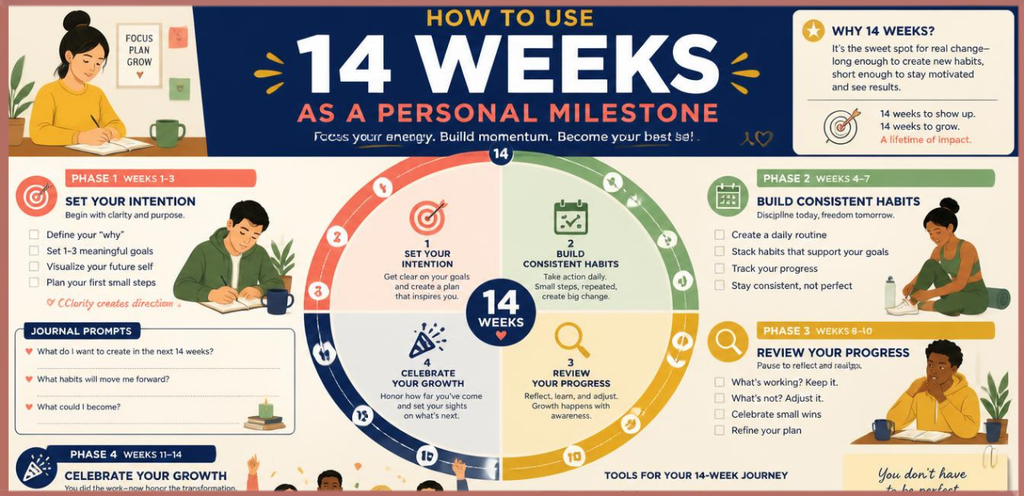
Fourteen weeks can be more meaningful when you stop treating it as one enormous block of time.
Suppose October 2 is your starting point. You might divide the journey into four stages. The first few weeks could be about beginning, the middle weeks about consistency, the later weeks about refinement, and the final stretch about finishing.
A person training for an event might track weekly progress. A parent preparing for a major family change might use the period for organizing practical details. Someone writing a book could set weekly word-count targets. A business owner could divide a campaign into research, preparation, launch, and review.
The exact goal doesn’t matter as much as the fixed endpoint.
January 8 becomes a little flag planted in the future saying: this is where I want to look back and see what changed.
How to Avoid Common Date Calculation Mistakes
The biggest mistake is confusing weeks with months. 14 weeks in days is exactly 98, while “three months” can represent different numbers of days depending on the calendar.
Another common error is counting the starting date twice. If October 2 is day zero for a forward calculation, then 98 days later is January 8. Treating October 2 itself as the first completed day can produce an off-by-one error.
It is also easy to forget that a phrase such as “five weeks ago” depends on the date when the question is asked. Relative dates are moving targets.
For important deadlines, appointments, travel, legal documents, or financial obligations, it is sensible to use the actual fixed calendar date rather than relying on a phrase like “14 weeks from today.” That small habit prevents a fair amount of calendar confusion.
Frequently Asked Questions About 14 Weeks From Today
What is 14 weeks from October 2, 2026?
14 weeks from October 2, 2026 is January 8, 2027, a Friday.
How many days are in 14 weeks?
There are 98 days in 14 weeks, because 14 × 7 = 98.
What day will it be weeks is 98 days, while three calendar months can contain 89, 90, 91, or 92 days depending calendar contains anniversaries connected with civil rights, aviation, economic history, war, diplomacy, political October 2 is simply a Friday until you attach a plan to it. January 8 is simply another Friday until you decide that it is the day a goal ends, a journey begins, a project gets delivered, or a promise you made to yourself gets 14 weeks from today?
Starting from Friday, October 2, 2026, fourteen complete weeks later is Friday, January 8, 2027. A whole number of weeks always preserves the same weekday.
Is 14 weeks the same as three months?
Not exactly. Fourteen weeks is 98 days, while three calendar months can contain 89, 90, 91, or 92 days depending on the months involved.
What is the date 14 weeks before October 2, 2026?
The date 14 weeks before October 2, 2026 is June 27, 2026.
Can I calculate 14 weeks using a date calculator?
Yes. Enter October 2, 2026 as the starting date, select the option to add weeks, enter 14, and the resulting future date should be January 8, 2027..
Frequently Asked Question
what date was 14 weeks ago
14 weeks ago from today, October 2, 2026, was June 26, 2026. This date falls exactly 14 weeks before today.
14 weeks from today date
14 weeks from today, October 2, 2026, is January 8, 2027. This is the exact future date after 14 weeks
what is the date 14 weeks from today
The date 14 weeks from today is January 8, 2027. You can use a date calculator to calculate other future or past dates.
when is 14 weeks from today
14 weeks from today will be Friday, January 8, 2027. This is 98 days after October 2, 2026.
14 weeks from.today
14 weeks from today is January 8, 2027, based on today’s date, October 2, 2026.
Read this blog https://lunavexory.com/45-days-ago-from-today/
Final Thoughts: A Small Question With a Surprisingly Useful Answer
At first, what is 14 weeks from today sounds like the sort of question you ask because you’re bored for thirty seconds. Yet the answer can become a useful little anchor for real life.
Starting from October 2, 2026, fourteen weeks carries you 98 days into the future, to January 8, 2027. It crosses three months, enters a new year, and lands on a Friday. Along the way, the same calendar contains anniversaries connected with civil rights, aviation, economic history, war, diplomacy, political change, and enormous social transformations.
That’s one of the charming things about dates: they are both ordinary and enormous. October 2 is simply a Friday until you attach a plan to it. January 8 is simply another Friday until you decide that it is the day a goal ends, a journey begins, a project gets delivered, or a promise you made to yourself gets checked off.
So if you came looking for the exact date 14 weeks from today, now you have it: January 8, 2027.
And maybe write it somewhere you’ll actually see it. Calendars have a sneaky habit of moving faster than we expect.