
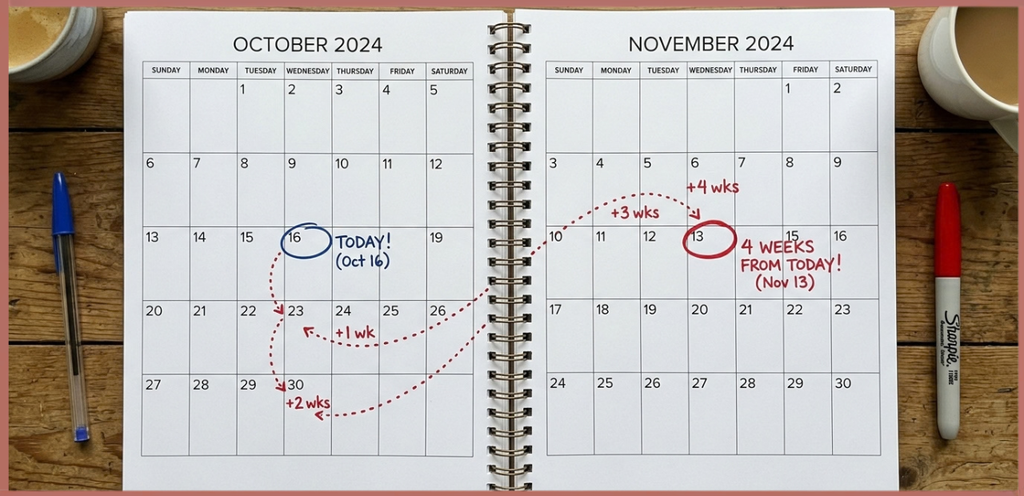
When you are planning something important, even a few weeks can feel like a long stretch of time. Maybe you are waiting for a special occasion, preparing for a family gathering, setting a personal goal, or simply wondering what the calendar will look like next month. Knowing what is 4 weeks from today makes it easier to turn a vague plan into a date you can actually mark on your calendar.
As of October 8, 2026, the date 4 weeks from today is November 5, 2026, a Thursday. Four weeks is equal to 28 days, so finding the answer is simply a matter of adding 28 days to today’s date. It sounds straightforward, and it really is once you understand how the calendar works.
A Simple Date Calculator can do this calculation in seconds, but learning the process yourself is useful, too. Whether you need to schedule an appointment, organize a project, plan a trip, or keep track of an upcoming deadline, knowing how to calculate future dates can save you time and confusion.
| Calculation | Date |
|---|---|
| Today | October 8, 2026 |
| 4 Weeks From Today | November 5, 2026 |
| Day of the Week | Thursday |
| Total Days | 28 Days |
What Is 4 Weeks From Today?
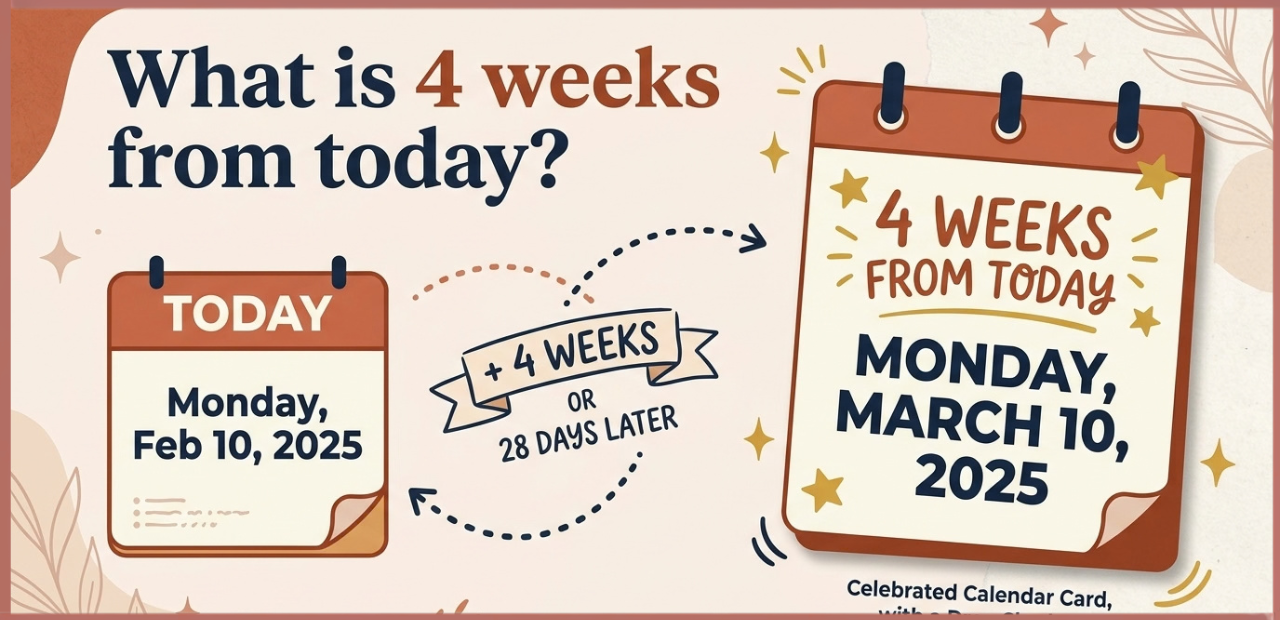
The answer to what is 4 weeks from today depends on the current date. Using October 8, 2026, as today’s date, adding four complete weeks brings us to November 5, 2026.
Here is a quick look at the calculation.
| Date detail | Answer |
|---|---|
| Today’s date | October 8, 2026 |
| Number of weeks | 4 weeks |
| Equivalent number of days | 28 days |
| Date 4 weeks from today | November 5, 2026 |
| Day of the week | Thursday |
| Month of the result | November |
| Calculation | October 8 + 28 days |
This result represents four full seven-day periods. The calendar moves from Thursday, October 8, to Thursday, November 5, without changing the day of the week.
If you are planning something for that date, write it down now. A small note in your phone or calendar can make the next four weeks feel more organized, especially when several deadlines are approaching at once.
How to Calculate 4 Weeks From Today
Calculating a future date doesn’t require complicated mathematics. You only need the starting date and the number of weeks you want to move forward.
One week contains seven days. Therefore, four weeks contain:
4 × 7 = 28 days
To find the Date 4 weeks from today, add 28 days to October 8, 2026.
October has 31 days. From October 8 to October 31, there are 23 days of elapsed time. That leaves five additional days to reach the final date in November.
October 8 + 28 days = November 5, 2026.
This is how to calculate a date by adding weeks without counting every individual day on your fingers. You can also move forward four rows on a traditional weekly calendar, keeping in mind that each row usually represents seven days.
For anyone asking, what date will it be 4 weeks from today?, the answer is November 5, 2026, when starting from October 8, 2026.
What Day Will It Be 4 Weeks From Today?
Four weeks from October 8, 2026, will be Thursday, November 5, 2026.
The reason is simple: adding a whole number of seven-day weeks preserves the weekday. If today is Thursday, one week later will be Thursday again, and the same pattern continues for two, three, and four weeks.
This detail is especially useful when making recurring appointments or planning weekly activities. For example, if you attend a class every Thursday, four weeks from your current class date will fall on another Thursday.
The same principle works for any starting weekday:
- Monday plus four weeks gives Monday.
- Tuesday plus four weeks gives Tuesday.
- Wednesday plus four weeks gives Wednesday.
- Thursday plus four weeks gives Thursday.
- Friday plus four weeks gives Friday.
- Saturday plus four weeks gives Saturday.
- Sunday plus four weeks gives Sunday.
So, if you are wondering what day of the week will it be in four weeks?, you don’t need to count the weekdays individually. Just keep the starting weekday and move the calendar forward by 28 days.
4 Weeks From Today on the Calendar
A calendar makes the relationship between today’s date and a future date much easier to understand. The following milestones show how four weeks unfold from October 8, 2026.
| Time interval | Date | Day |
|---|---|---|
| Starting date | October 8, 2026 | Thursday |
| 1 week from today | October 15, 2026 | Thursday |
| 2 weeks from today | October 22, 2026 | Thursday |
| 3 weeks from today | October 29, 2026 | Thursday |
| 4 weeks from today | November 5, 2026 | Thursday |
Notice how each date is exactly seven days after the previous one. This predictable pattern is what makes a Calendar Calculator by Weeks useful for planning events, work schedules, personal milestones, and recurring commitments.
It is also helpful when the future date crosses from one month into another. You don’t need to restart the calculation or treat November as an entirely separate problem. Simply continue counting the days.
How Many Days Are in 4 Weeks?
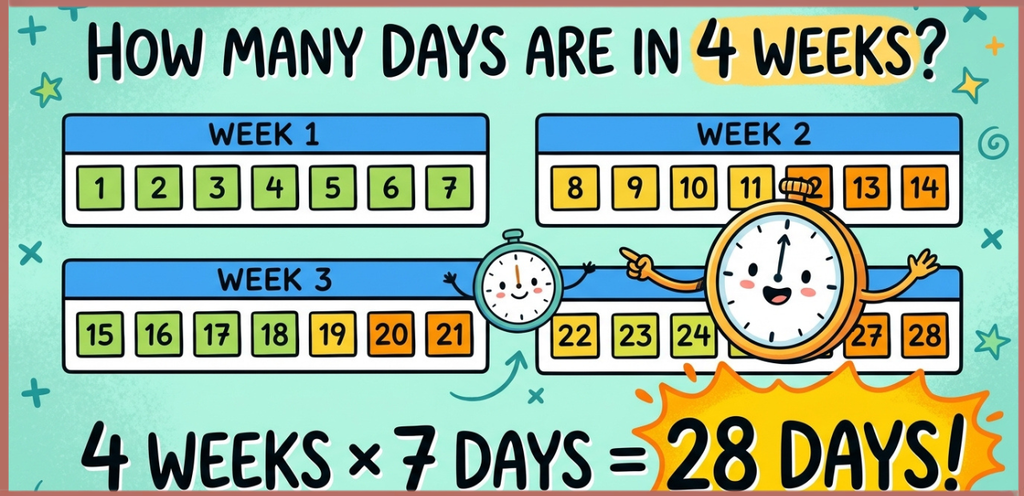
There are 28 days in four weeks because each week has seven days.
The calculation is:
4×7=28
This is a fixed relationship, regardless of which month you are in. However, the calendar date reached after those 28 days depends on your starting date.
For example, adding 28 days to October 8, 2026, gives November 5, 2026. Starting from a different date would produce a different result.
The distinction matters when you are working with deadlines. Four weeks is not the same as one calendar month in every situation. A calendar month may have 28, 29, 30, or 31 days, whereas four weeks always equals 28 days.
If an employer, school, service provider, or contract specifies a deadline of four weeks, check whether it means 28 elapsed days or a calendar-month period. In ordinary date calculations, four weeks means 28 days.
What Is 28 Days From Today?
The answer to what is 28 days from today is the same as the answer to four weeks from today, provided you use the same starting date and counting convention.
Starting on October 8, 2026:
- Today’s date is October 8, 2026.
- The time interval is 28 days.
- The future date is November 5, 2026.
- The weekday remains Thursday.
This calculation is useful for subscription renewals, personal challenges, study plans, fitness goals, and project reviews. For instance, you might decide to practice a new skill every day for 28 days and review your progress on November 5.
Remember that counting methods can sometimes cause confusion. If October 8 is treated as day one of a 28-day inclusive count, the 28th calendar day would be November 4. Standard date arithmetic, however, adds 28 elapsed days to October 8 and returns November 5.
When using a Date Calculator, check whether the task involves adding elapsed days or counting both the starting and ending dates inclusively.
How to Use a Weeks Calculator
A Weeks Calculator makes it easier to find dates in the past or future without manually counting each day. It is especially helpful when the interval is longer than a few weeks or when you need to compare several dates.
Most online calculators follow a simple process.
- Open a Date Calculator Online tool.
- Choose the starting date, such as October 8, 2026.
- Select the option to add weeks or calculate a future date.
- Enter four weeks as the desired interval.
- Press the calculate button.
- Check the displayed date and weekday.
A Future Date Calculator performs the date arithmetic automatically. Some tools also let you subtract weeks, calculate the difference between two dates, or convert weeks into days.
A Date and Time Calculator may offer additional features, such as adding hours or minutes. These options are useful if your calculation involves a precise time as well as a calendar date.
For a straightforward question like how to calculate 4 weeks from a date, multiplying the number of weeks by seven is usually all you need. The calculator simply saves you the effort of working through the calendar yourself.
Why Use a Date Calculation Tool?
A Date Calculation Tool can be useful whenever an upcoming date matters. While counting four weeks is easy, longer intervals and dates crossing multiple months can be harder to manage accurately.
Here are several reasons to use a date calculator:
- Planning deadlines: Work backward from a delivery date or move forward from the day a project begins.
- Managing appointments: Find a date for a follow-up appointment scheduled four weeks after the previous visit.
- Organizing travel: Estimate future departure or return dates.
- Tracking personal goals: Set a date to review progress after a 28-day challenge.
- Scheduling recurring events: Keep weekly meetings aligned with the correct weekday.
- Checking date intervals: Find the number of days or weeks between two dates.
- Planning reminders: Identify the exact date when a task should be completed.
An Exact Date Calculator is particularly useful when you need an answer quickly and want to avoid mistakes caused by different month lengths.
You may also find a Days, Weeks, and Months Calculator helpful if your plans involve several types of time intervals. Rather than converting everything manually, you can enter the values and let the tool calculate the result.
Relative Dates and Future Date Planning

Relative dates describe a date in relation to another date. Phrases such as today, tomorrow, four weeks from now, and two weeks ago are common examples.
The advantage of Relative Dates is that they make time easier to discuss without always writing a full calendar date. The disadvantage is that they can become unclear when a message is read several days later.
For example, saying “the report is due four weeks from today” may be clear when you send the message on October 8. But if someone reads it on October 12, they might mistakenly calculate from their own current date.
For important plans, write the exact date alongside the relative expression:
“The report is due four weeks from October 8, 2026, on Thursday, November 5, 2026.”
This small habit helps prevent misunderstandings. It is particularly useful for business communication, appointment confirmations, project updates, and messages sent across different time zones.
A Relative Date Range can also describe a period rather than a single date. For instance, a four-week planning window beginning October 8 and ending November 5 represents 28 elapsed days between those dates. If both endpoint dates are included as calendar days, the list contains 29 dates.
That difference is worth remembering whenever you are building schedules, tracking daily activities, or calculating reporting periods.
What Was 4 Weeks Ago?
Moving backward four weeks follows the same method as moving forward, except you subtract 28 days instead of adding them.
Starting from October 8, 2026, subtracting 28 days gives September 10, 2026, which was a Thursday.
| Calculation | Result |
|---|---|
| Starting date | October 8, 2026 |
| Interval | 4 weeks ago |
| Days subtracted | 28 |
| Past date | September 10, 2026 |
| Day of the week | Thursday |
This calculation can help you review previous appointments, check when a task started, or determine the date of an earlier event.
A Date Interval Calculator can handle both directions. Choose the starting date and subtract the desired number of weeks to identify the date in the past.
The same approach works for longer periods. Eight weeks ago means subtracting 56 days, while twelve weeks ago means subtracting 84 days. Once you understand the seven-day relationship, these calculations become much less intimidating.
How to Calculate Dates Across Different Months
Adding weeks becomes a little more interesting when the result crosses a month boundary. Every month has a different number of days, so you cannot always find a future date by adding the same number to the day of the month.
Consider October 8, 2026, as an example. October has 31 days, and the target date falls in November.
To calculate the result:
- Count 23 days from October 8 to October 31.
- Subtract 23 from the 28-day interval.
- You have five days remaining.
- Count five days into November to reach November 5.
This is a practical way to calculate future dates without relying on guesswork.
You can use the same method for other dates, although a leap year may affect February calculations. A calendar calculator handles these differences automatically, making it convenient when you need to add or subtract weeks from several dates.
If you’re calculating a date close to the end of a month, it is often safer to use the full calendar rather than assuming the next month begins after a fixed number of days.
Practical Examples of Four-Week Date Calculations
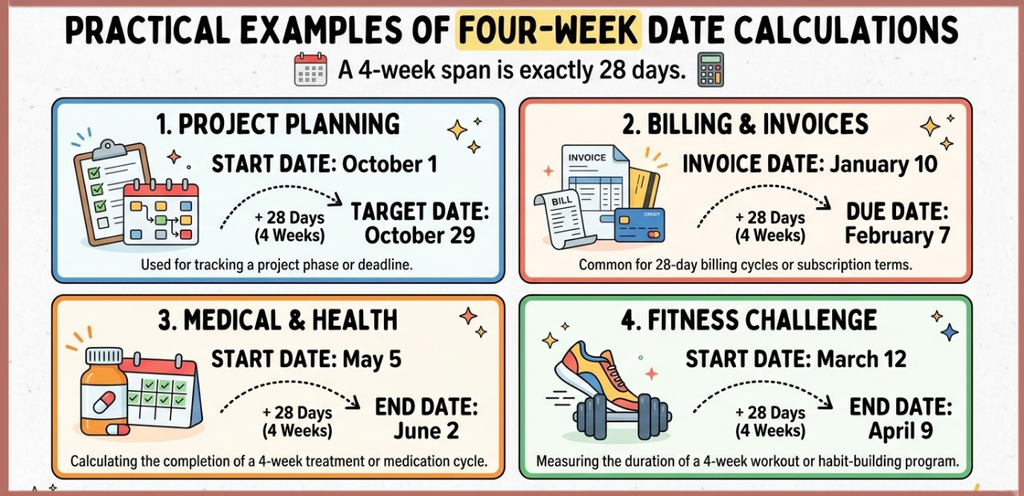
Four-week calculations can be used in everyday situations, from professional deadlines to personal plans. Here are a few examples showing how the method works.
Planning a project deadline
Suppose a project begins on October 8, 2026, and needs to be completed within four weeks. Adding 28 days gives November 5, 2026. You can then work backward from the deadline to create weekly milestones.
Scheduling a recurring appointment
If an appointment takes place on a Thursday and the next appointment is scheduled four weeks later, the new appointment will also fall on a Thursday. Confirm the actual calendar date before making the booking.
Organizing a study plan
A student beginning a 28-day study challenge on October 8 can plan to review progress on November 5. Weekly check-ins on October 15, October 22, and October 29 provide useful opportunities to adjust the routine.
Tracking a personal goal
Someone starting a daily writing, reading, or exercise habit on October 8 may use November 5 as a progress-review date. The four-week interval provides a clear point for reflection without making the goal feel too distant.
Preparing a reminder
If you need to send a reminder four weeks after an event, enter the event date into a Simple Date Calculator and add 28 days. Writing down the exact date can help prevent missed follow-ups.
These examples demonstrate that a date calculation is more than a number on a calendar. It is a simple planning tool that can make daily responsibilities easier to manage.
Frequently Asked Questions
What is 4 weeks from today?
Four weeks from October 8, 2026, is Thursday, November 5, 2026. Four weeks equals 28 days.
What date is 4 weeks from now?
Using October 8, 2026, as the starting date, the date four weeks from now is November 5, 2026. The result may differ when today’s date changes.
What day will it be 4 weeks from today?
It will be Thursday, November 5, 2026. Adding a complete number of weeks preserves the weekday.
How many days are 4 weeks?
Four weeks contain 28 days because each week has seven days. The calculation is 4 × 7 = 28.
What is 28 days from today?
Twenty-eight days after October 8, 2026, is November 5, 2026. This is the same result as adding four weeks.
How do you calculate 4 weeks from a date?
Multiply four by seven to get 28 days, then add those days to the starting date. For October 8, 2026, the result is November 5, 2026.
What was 4 weeks ago?
Four weeks before October 8, 2026, was Thursday, September 10, 2026. Subtracting 28 days gives the past date.
What date is 4 weeks ahead?
Four weeks ahead of October 8, 2026, is November 5, 2026. A future date calculator can confirm the result automatically.
How do I use a weeks calculator?
Enter the starting date, choose the option to add weeks, type four, and calculate. The tool will display the resulting date, and some calculators also show the weekday.
Can I calculate future dates online?
Yes. An online week calculator or date calculator can add or subtract weeks, calculate dates relative to today, and find intervals between two dates.
Frequently Asked Question
What was 4 weeks ago from today
Four weeks ago from October 8, 2026, was Thursday, September 10, 2026.
4 weeks ago today
Four weeks ago today was September 10, 2026, exactly 28 days before October 8, 2026.
4 weeks from today is what date
Four weeks from today is Thursday, November 5, 2026, which is 28 days after October 8, 2026.
4 week from today
Four weeks from today falls on Thursday, November 5, 2026. You can use a date calculator to find future dates easily.
4 weeks from today date
The date four weeks from today, October 8, 2026, is November 5, 2026, a Thursday.
Read thid blog https://lunavexory.com/14-weeks-from-now/
Conclusion
Knowing what is 4 weeks from today gives you a simple, reliable starting point for organizing the days ahead. From October 8, 2026, four weeks brings you to Thursday, November 5, 2026. The interval is exactly 28 days, and the weekday remains Thursday.
You can work out the answer manually by multiplying the number of weeks by seven, or use a Future Date Calculator when you need a quick result. Both approaches are useful, especially when you are planning deadlines, arranging appointments, or keeping track of personal goals.
The most practical habit is to pair relative dates with exact calendar dates. Instead of writing only “four weeks from now,” include the date you mean. It takes just a moment, but it can prevent confusion later.
A calendar is, in its own quiet way, a map of the things we hope to do. Mark November 5, 2026, if it matters to your plans, and give yourself a clear destination to work toward.